

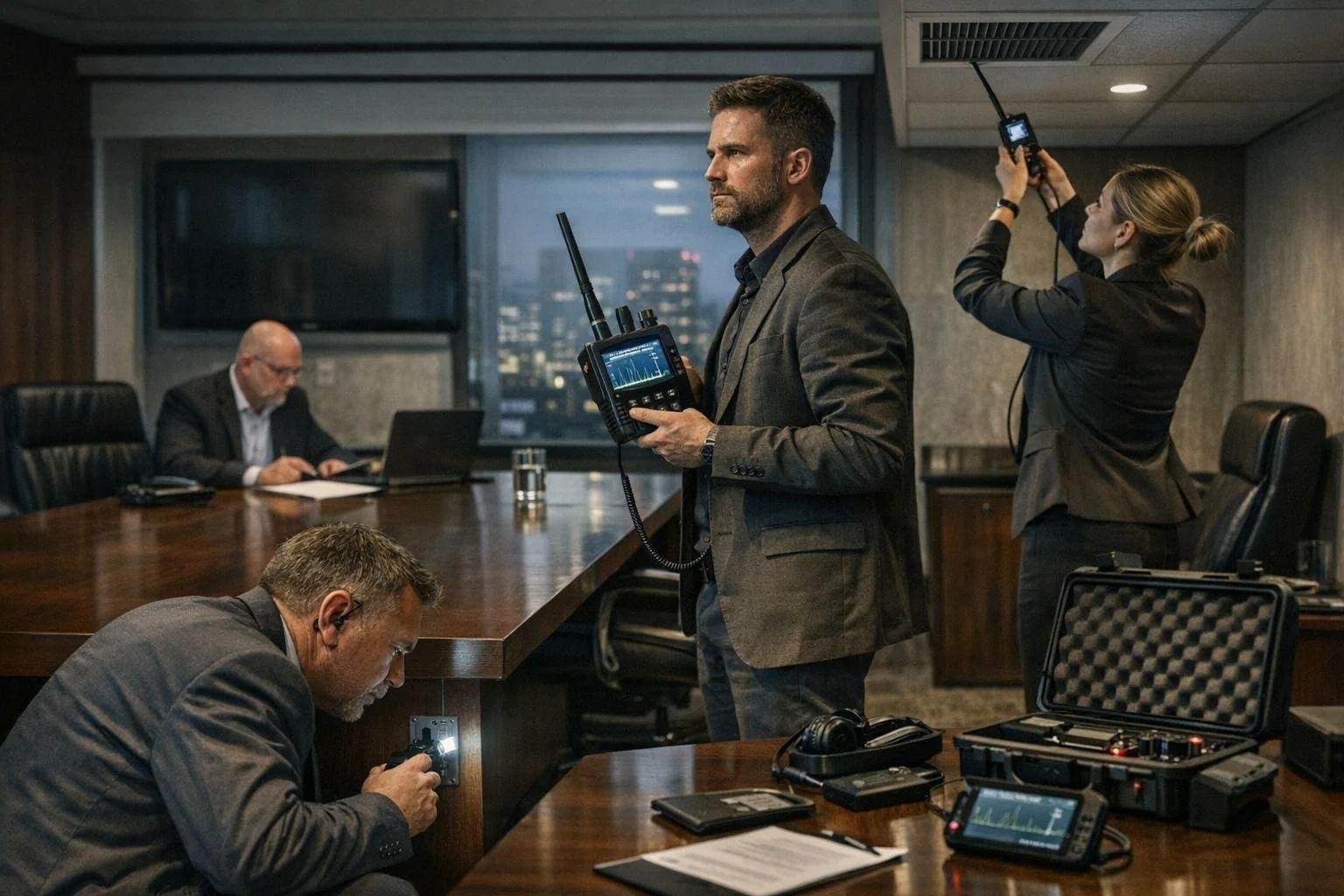
Why Basic Bug Detectors May Not Be Enough: Understanding Professional TSCM Equipment
Concerns about hidden cameras, listening devices, and unauthorized electronic surveillance have made bug detection an important consideration for individuals, businesses, and organizations. With numerous consumer-level bug detectors available online, identifying potential surveillance equipment may appear relatively simple. However, detecting sophisticated electronic devices often requires more than a handheld detector or a basic scanning application.
Electronic surveillance devices can operate through different technologies, transmission methods, and physical configurations. Some may transmit wireless signals, while others may record information locally without continuously transmitting anything. Certain devices may also be integrated into everyday electronic equipment, making identification more challenging through ordinary visual checks.
This is where Technical Surveillance Countermeasures (TSCM) become relevant. Professional TSCM inspections use specialized equipment, systematic examination procedures, and technical expertise to assess potential electronic surveillance risks.
For individuals and businesses considering professional bug sweeping services in Ahmedabad, understanding the difference between consumer-level detectors and professional TSCM equipment is an important first step.
What Are Basic Bug Detectors, and How Do They Work?
Basic bug detectors are consumer-oriented devices designed to identify certain indicators associated with electronic surveillance equipment.
Depending on their design and capabilities, these devices may detect radio frequency (RF) transmissions, identify some magnetic components, or help locate visible camera lenses through optical reflection techniques.
Some commonly available detection devices include:
- RF signal detectors: Designed to identify certain radio frequency transmissions within supported frequency ranges.
- Hidden camera lens finders: Use optical reflection techniques to help identify camera lenses.
- Magnetic field detectors: Identify certain magnetic fields that may be associated with particular electronic or tracking devices.
- Combination bug detectors: Combine selected detection functions into one portable device.
These products may provide an initial indication of certain electronic activity. However, their effectiveness depends on sensitivity, frequency coverage, device configuration, surrounding interference, and the technology being investigated.
A basic detector should not be considered a comprehensive solution for identifying every type of hidden surveillance device.
Why Consumer-Level Bug Detectors Have Limitations
Although consumer bug detectors can be useful for preliminary checks, their capabilities are generally narrower than those of specialized professional TSCM equipment.
Understanding these limitations helps explain why a more systematic inspection may be necessary in environments where confidentiality is important.
1. Limited Frequency Coverage
Many basic RF detectors operate within specific frequency ranges. If a suspected surveillance device uses a frequency outside the detector's supported range, it may not be identified.
Professional TSCM equipment can provide broader frequency analysis capabilities, depending on the instruments and inspection requirements.
2. Difficulty Identifying Non-Transmitting Devices
Not every surveillance device continuously transmits information.
Some equipment stores recorded audio or video locally and may only transmit data under particular conditions.
An RF detector cannot identify a device simply because it is recording locally without generating a detectable transmission.
3. False Alerts from Everyday Electronics
Modern environments contain numerous wireless devices, including Wi-Fi routers, Bluetooth accessories, mobile phones, smart televisions, and other connected equipment.
These devices generate legitimate electronic activity that may trigger alerts on basic detectors.
Without technical interpretation, distinguishing ordinary wireless activity from potentially relevant signals can be difficult.
4. Limited Identification Capabilities
A basic detector may indicate the presence of radio frequency activity without identifying the source, purpose, or nature of the signal.
Professional inspections involve analyzing the surrounding electronic environment and evaluating findings in context.
5. Lack of Systematic Physical Inspection
Electronic surveillance devices may be concealed within objects, fixtures, equipment, or structural spaces.
A handheld RF detector alone cannot comprehensively examine physical installations or identify every type of concealed electronic component.
This is why professional TSCM inspections combine electronic analysis with appropriate physical examination techniques.
What Makes Professional TSCM Equipment Different?
Professional Technical Surveillance Countermeasures involve a structured approach to identifying and assessing potential electronic surveillance threats.
Rather than relying on one detection method, a professional inspection may involve multiple instruments, each designed to examine a particular aspect of the electronic environment.
The selection of equipment depends on the environment, the nature of the concern, and the suspected surveillance technology.
Some of the specialized instruments used in professional debugging inspections include the following.
1. Spectrum Analyzers: Examining Radio Frequency Activity
Spectrum analyzers are important instruments in professional electronic surveillance detection.
They help examine radio frequency activity across selected frequency ranges and display signal characteristics that can be evaluated by a trained specialist.
During a TSCM inspection, spectrum analysis may help with:
- Identifying unusual RF activity.
- Examining signal strength and frequency characteristics.
- Observing changes in the surrounding RF environment.
- Investigating potentially relevant wireless transmissions.
- Distinguishing known environmental signals from activity requiring further assessment.
However, detecting an unfamiliar signal does not automatically indicate the presence of a surveillance device. Professional interpretation is necessary to understand its potential significance.
2. Non-Linear Junction Detectors (NLJDs): Identifying Electronic Components
A non-linear junction detector, commonly known as an NLJD, is a specialized instrument used to identify electronic semiconductor junctions within inspected materials and structures.
Unlike conventional RF detectors, an NLJD does not depend on an electronic device actively transmitting a wireless signal.
It works by transmitting a radio frequency signal and analyzing harmonic responses generated by non-linear electronic junctions.
Professional specialists may use NLJDs to investigate:
- Concealed electronic circuits.
- Semiconductor components.
- Electronic devices that are not actively transmitting.
- Certain concealed electronic assemblies within inspected objects or structures.
NLJD findings also require careful interpretation because other materials and electronic components can produce responses. An NLJD is not a universal detector for every hidden device.
3. Thermal Imaging Equipment: Examining Unusual Heat Patterns
Thermal imaging equipment detects variations in surface temperature and converts them into visual thermal representations.
During certain technical inspections, thermal cameras may help examine unusual heat patterns around electrical installations, equipment, or enclosed spaces.
Potential applications include:
- Examining unusual temperature variations.
- Identifying unexpected heat sources.
- Investigating electronic equipment operating under specific conditions.
- Supporting further physical examination where appropriate.
Thermal imaging cannot independently establish whether a surveillance device is present. Temperature variations can have many ordinary explanations, so findings must be assessed alongside other inspection methods.
4. Telephone and Line Analysis Equipment
In certain environments, concerns may involve communication infrastructure rather than wireless surveillance equipment.
Specialized telephone and line analysis instruments may be used to assess relevant wired communication systems, depending on the scope of the inspection.
These instruments can help evaluate:
- Electrical characteristics of communication lines.
- Unusual connections or configurations.
- Certain irregularities in wired communication infrastructure.
- Potential technical issues requiring additional investigation.
Such assessments are particularly relevant when the inspection involves sensitive office communication systems or specialized infrastructure.
5. Optical Inspection and Endoscopic Equipment
Some concealed devices may be located in areas that are difficult to examine through ordinary visual inspection.
Optical inspection equipment, including specialized endoscopes and borescopes, can help examine restricted spaces and internal areas where appropriate.
These tools may support inspections of:
- Concealed cavities.
- Accessible structural spaces.
- Equipment enclosures.
- Difficult-to-view installation areas.
Their use depends on the inspection scope, physical accessibility, and permission to examine the relevant property or equipment.
Basic Bug Detectors vs Professional TSCM Equipment
Understanding the differences between these two approaches can help individuals and organizations make more informed decisions.
|
Evaluation factor |
Basic bug detectors |
Professional TSCM equipment |
|
RF detection |
Usually, limited frequency coverage |
Advanced frequency analysis capabilities |
|
Signal interpretation |
Basic alerts or indicators |
Detailed technical evaluation |
|
Non-transmitting devices |
Generally limited |
May include an NLJD-based examination |
|
Physical inspection |
Limited |
Can involve specialized inspection instruments |
|
Environmental analysis |
Basic |
Structured assessment of electronic activity |
|
Technical expertise |
Depends on user knowledge |
Conducted by trained specialists |
|
Inspection scope |
Usually, narrow |
Selected according to the inspection requirements |
The important distinction is not simply the sophistication of the equipment. Professional TSCM inspections also depend on the examiner's ability to select appropriate instruments, interpret findings, and investigate relevant concerns systematically.
Why Professional TSCM Inspections Matter for Businesses in Ahmedabad
Ahmedabad has a diverse commercial and industrial environment, with businesses operating across manufacturing, finance, technology, trading, and professional services.
Many organisations regularly handle information that requires appropriate confidentiality measures.
Areas that businesses may consider for professional TSCM assessments include:
Executive offices: Spaces where sensitive business decisions, negotiations, and strategic discussions take place.
Conference rooms: Meeting environments used for confidential presentations, commercial negotiations, and internal planning.
Boardrooms: Locations where management discussions, financial matters, and organisational decisions are addressed.
Residential premises: Private properties where specific concerns about unauthorised electronic surveillance may warrant professional assessment.
Vehicles: Business and executive vehicles where concerns involving unauthorised tracking or electronic monitoring may require specialised inspection.
The appropriate inspection frequency depends on operational requirements, confidentiality concerns, environmental changes, and the organisation's overall risk assessment.
How a Professional TSCM Bug Sweeping Inspection Is Conducted
Professional bug sweeping is not simply a matter of switching on a detection device and checking for alerts. It involves an organised examination based on the property's characteristics and the concerns being investigated.
A typical inspection may include the following stages.
Step 1: Initial Consultation and Requirement Assessment
The inspection begins with understanding the client's concerns, the nature of the premises, and the areas requiring examination.
Step 2: Preliminary Physical Assessment
Relevant spaces, fixtures, electronic installations, and accessible equipment are examined for unusual modifications or other indicators requiring further investigation.
Step 3: RF Spectrum Analysis
Specialised equipment may be used to examine radio frequency activity and investigate signals that require additional technical assessment.
Step 4: Specialised Electronic Examination
Depending on the environment and inspection objectives, instruments such as NLJDs and other specialised equipment may be used to examine relevant areas and objects.
Step 5: Evaluation of Findings
Observations and instrument readings are assessed in context. Unusual readings are not automatically treated as evidence of surveillance.
Step 6: Reporting and Recommendations
The findings are communicated to the client, along with relevant observations and recommendations for appropriate next steps.
The specific instruments and procedures used will vary according to the inspection requirements. Not every instrument is necessary for every property.
Frequently Asked Questions (FAQs)
1. Are basic bug detectors effective at finding hidden cameras?
Basic detectors may identify certain wireless transmissions or help locate some camera lenses. However, their capabilities depend on the device's design and detection method. They cannot reliably identify every type of hidden camera, particularly devices that do not transmit wirelessly.
2. What equipment do professional TSCM specialists use?
Professional TSCM inspections may involve spectrum analysers, Non-Linear Junction Detectors (NLJDs), thermal imaging equipment, telephone line analysis instruments, and specialised optical inspection tools.
3. Can professional TSCM equipment detect devices that are switched off?
Some specialised instruments, such as NLJDs, can identify certain electronic semiconductor components without requiring the device to transmit an active wireless signal. However, detection depends on the device, its construction, the inspection environment, and equipment capabilities. No instrument guarantees detection of every device.
4. What is the difference between an RF detector and a spectrum analyser?
An RF detector generally indicates the presence of certain radio frequency activity, depending on its capabilities. A spectrum analyser provides more detailed information about signals across selected frequency ranges, allowing specialists to examine signal characteristics and investigate unusual activity.
5. Are professional bug sweeping services suitable for residential properties?
Yes. Homeowners may consider professional TSCM inspections when they have specific concerns about unauthorised electronic surveillance. The inspection scope can be adapted to the property's layout and the nature of the concern.
6. How often should an office undergo a TSCM inspection?
There is no universal inspection schedule. Frequency depends on business confidentiality requirements, changes to the premises, operational risks, and specific concerns. Organisations handling highly sensitive information may consider periodic assessments.
7. Do professional bug sweeping services guarantee that every hidden device will be found?
No professional inspection should guarantee the detection of every possible surveillance device. Results depend on the equipment, inspection conditions, device characteristics, and examination scope. A responsible provider should clearly explain these limitations.
How to Choose the Right Bug Sweeping Service Provider
When selecting a professional TSCM company in Ahmedabad, equipment availability is only one part of the decision.
Individuals and businesses should also consider:
- Technical expertise: Does the provider have relevant experience in electronic surveillance detection?
- Equipment capabilities: Does the inspection involve appropriate professional instruments?
- Inspection methodology: Is there a clearly explained and structured process?
- Confidentiality: Are information-handling practices explained before the inspection?
- Reporting standards: Are findings communicated clearly and responsibly?
- Inspection scope: Does the provider understand the specific requirements of the property or environment?
Avoid providers who guarantee that every possible surveillance device can be detected or make unrealistic claims about the accuracy of their equipment.
A credible TSCM inspection should be based on appropriate technical methods, professional assessment, and realistic explanations of its scope and limitations.
Professional TSCM Debugging and Bug Sweeping Services in Ahmedabad by Trace Point India
When electronic surveillance concerns arise, relying entirely on basic consumer-level detection equipment may not provide the level of assessment required for sensitive environments.
Professional TSCM inspections involve a combination of specialised instruments, technical knowledge, and systematic examination procedures to evaluate potential electronic surveillance risks.
Trace Point India provides professional TSCM debugging and bug sweeping services for individuals, businesses, corporate offices, and other environments where electronic privacy is an important consideration.
The inspection approach may involve specialised equipment and techniques, including:
- RF spectrum analysis.
- Non-Linear Junction Detector (NLJD) inspections.
- Electronic surveillance detection.
- Physical examination of relevant areas.
- Assessment of potential wireless and wired surveillance concerns.
Whether you are reviewing the privacy of an executive office, evaluating a corporate meeting environment, or considering a residential inspection, selecting an appropriate professional assessment is an important step.
Concerned About Hidden Surveillance Devices?
Professional electronic surveillance detection requires more than basic bug detectors. Understand the inspection process and discuss your requirements with Trace Point India.


