

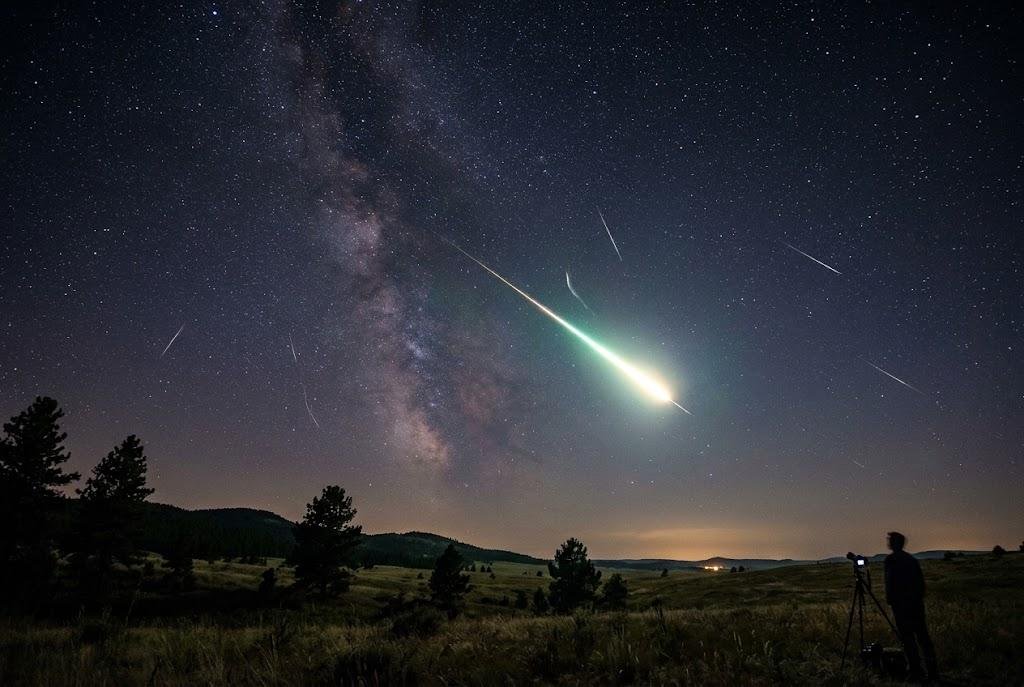

The Taurids are a meteor shower that lights up the night sky every autumn, named for the constellation Taurus, where their meteors appear to radiate from. Unlike flashier showers like the Perseids, the Taurids move slowly and sparsely across the sky rather than producing a dramatic burst. If you’ve ever heard someone mention “Halloween fireballs,” they were probably talking about the Taurids, since this shower tends to peak right around that holiday.
What makes the Taurids interesting is where they come from. These meteors are debris left behind by Encke’s Comet — one of the oldest comets we know of, still orbiting the sun on a short, tight loop. As Earth passes through this trail of ancient dust each year, tiny particles burn up in our atmosphere, and that’s what we see as the Taurids.
When to Watch the Taurids
There are actually two branches of the Taurids: the Southern Taurids and the Northern Taurids. The Southern Taurids are active from roughly late September through late November, usually peaking in early to mid-October. The Northern Taurids follow a few weeks later, typically peaking around late October into November. Because the two overlap, you can catch Taurid meteors across a long stretch of autumn rather than on just one or two nights.
The best time to watch the Taurids is after midnight, once Taurus has risen higher in the sky and the moon isn’t washing out the view. A clear, dark location away from city lights makes a huge difference — the Taurids aren’t usually a high-volume shower, so a few extra visible meteors per hour is worth the effort of finding darker skies. If you’re new to meteor watching in general, our guide to planning a stargazing night covers the basics of timing, gear, and finding a good viewing spot.
Why the Taurids Produce Fireballs
Most meteor showers produce quick, faint streaks, but the Taurids have a reputation for something more dramatic: fireballs. A fireball is simply a meteor that burns noticeably brighter than the rest, sometimes rivaling the brightness of Venus, and occasionally even casting shadows for a split second. The Taurids are known for producing a higher-than-average share of these bright events, which is part of why they’ve earned such a devoted following among skywatchers despite a relatively low overall meteor count.
The reason seems to lie in the size of the particles involved. While most meteor showers come from fine comet dust, some of the material in the Taurids is thought to be slightly larger, pebble-sized debris. Bigger particles burn longer and brighter, which is exactly the kind of fireball behavior the Taurids are known for.
The Taurid Swarm and Why Scientists Watch Closely
Every few years, Earth passes through a denser clump of material associated with the Taurids, sometimes called the “Taurid swarm.” During these years, observers tend to report noticeably more fireballs than usual. Researchers have taken a serious interest in the Taurids for exactly this reason: the stream is thought to contain larger fragments than most meteor showers, and understanding its structure helps scientists assess the broader population of near-Earth objects linked to Encke’s Comet.
This is also why the Taurids occasionally show up in science headlines beyond typical stargazing coverage. They’re treated less like a once-a-year curiosity and more like an ongoing research subject, with astronomers tracking how the swarm shifts and when Earth’s path might bring us closer to its densest regions.
Tips for Getting the Most Out of the Taurids
Because the Taurids are a slower, sparser shower, a little patience goes a long way. Give your eyes at least twenty minutes to adjust to the dark, avoid checking your phone screen, and settle in for a longer session rather than a quick five-minute glance outside. Lying back with a wide view of the sky, rather than fixating on one spot, gives you the best chance of catching one of the shower’s signature bright fireballs.
Layer up — Taurid season lands in the cooler months, and comfort matters if you’re planning to be outside for an hour or more. A reclining chair or blanket on the ground, a thermos of something warm, and a spot with minimal light pollution are really all you need. No telescope or binoculars required, since the Taurids are best seen with the naked eye across as wide a patch of sky as possible.
Whether you catch two meteors or twenty, the Taurids are a good reminder of how much quiet activity is happening overhead on an ordinary autumn night. They’re not the showiest event in the meteor calendar, but for patient observers, the Taurids consistently deliver a few memorable, bright surprises.


