

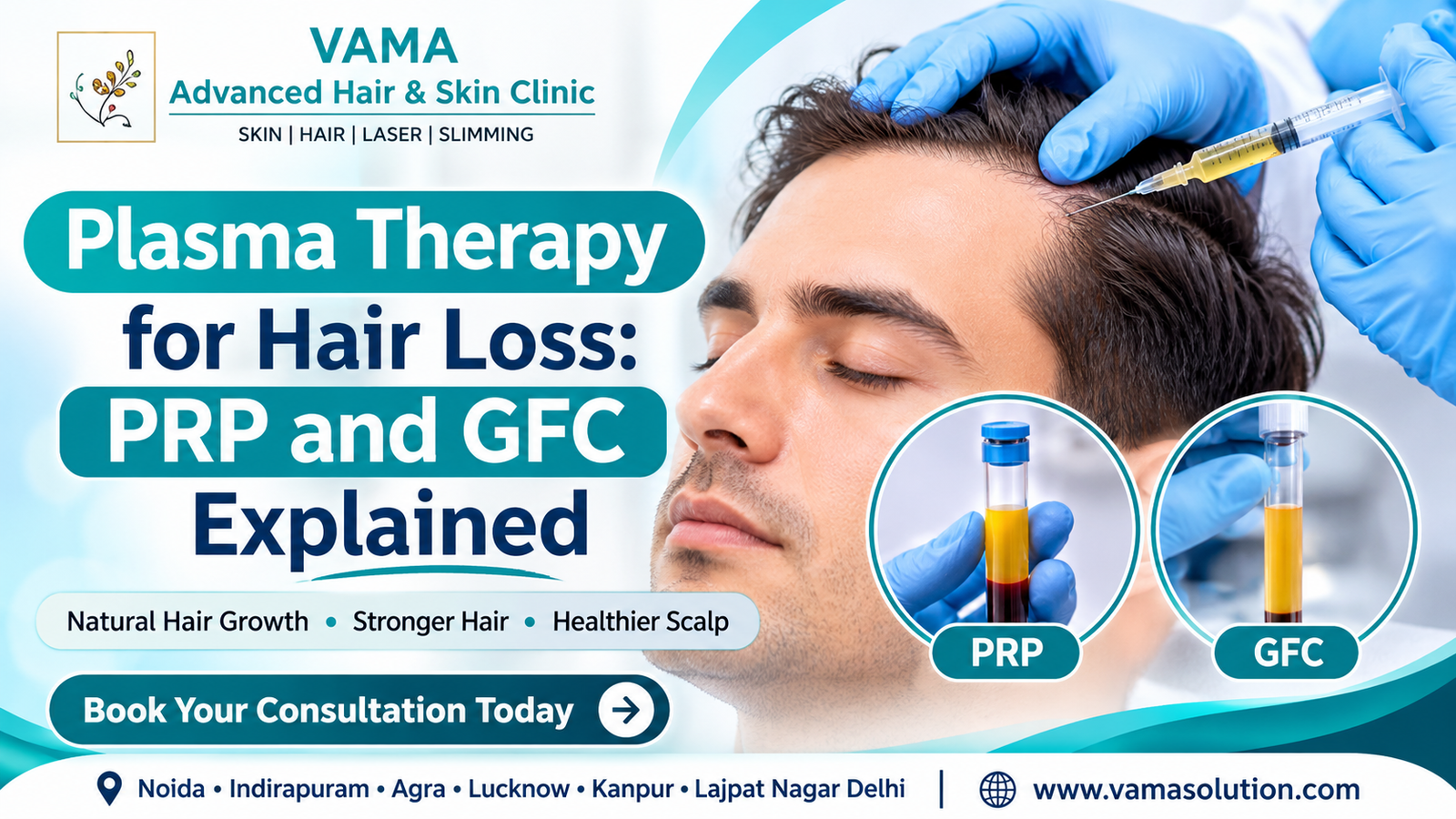

Few hair treatments sound as intriguing as this one: a small sample of your own blood, a short procedure and, over the next few months, hair that looks and feels stronger. No wonder PRP and GFC come up so often when people begin researching hair loss.
They also come with a lot of confusion. Some websites make plasma therapy sound like magic. Others dismiss it completely. The truth sits in the middle, and knowing where can save you time, money and disappointment.
At Vama Clinics, we explain this to patients every week, so here is the honest version. If you are looking for a hair clinic in Lucknow and want to understand plasma therapy before you book, this guide will walk you through how it works, who it helps, what to expect and when something else may be a better choice.
What Is Plasma Therapy for Hair?
Plasma therapy uses your own blood to support your scalp. A small sample is taken, much like a routine blood test, and spun in a machine called a centrifuge. This separates the blood into layers, and the part rich in platelets and growth-promoting proteins is collected. That concentrate is then placed into the scalp, usually with fine needles.
The idea is simple. Platelets carry proteins, known as growth factors, that play a role in the body’s natural repair processes. Placing a concentrated dose near the hair follicles is meant to support those follicles and improve the scalp environment.
If you are exploring plasma therapy for hair in Lucknow, you will mainly come across two versions: PRP and GFC.
PRP and GFC: What Is the Difference?
Both come from your own blood and aim at the same goal, but they are prepared a little differently.
PRP (platelet-rich plasma) is plasma containing a higher-than-normal concentration of platelets. It has been used for years in hair clinics, and the exact preparation can vary between clinics and devices.
GFC (growth factor concentrate) goes a step further. Rather than injecting the platelets themselves, the process focuses on collecting the growth factors they release. The result is meant to be a more purified preparation, usually with fewer blood cells mixed in.
Some clinics describe GFC as a more refined approach, and some patients find it more comfortable. It is worth being honest about what the research shows, though. Studies on both PRP and GFC for hair are mixed in quality and size, and results vary between people. Neither is a guaranteed fix, and a sensible doctor will say so. If someone tells you one is far superior to the other in every case, ask them to explain on what basis.
You can read more about our approach on our Hair PRP page and GFC page.
How Does the Treatment Work Step by Step?
Knowing what happens makes the first session far less nerve-racking. A typical session goes like this.
- Consultation and scalp check. The doctor examines your scalp and hair, asks about your history and decides whether plasma therapy suits you.
- Blood sample. A small amount of blood is drawn from your arm.
- Processing. The sample is spun in a centrifuge to separate out the platelet-rich portion or growth-factor concentrate.
- Scalp preparation. The scalp is cleaned, and a numbing cream or local anaesthetic may be used for comfort.
- Application. The concentrate is placed into the areas of thinning with fine needles.
- Aftercare. You get simple instructions, and most people go home the same day.
A session often takes under an hour in total. Most people return to normal activities quickly, though a little redness, tenderness or mild swelling is common for a day or two.
Who Is Plasma Therapy Meant For?
Plasma therapy tends to be considered for people whose hair is thinning but whose follicles are still active. This might include:
- Early or moderate pattern hair thinning
- Reduced hair thickness and density
- Hair loss that is being managed alongside medical treatment
- People who want to support results after a transplant
It is generally not meant for areas that are completely bald with no active follicles. Once a follicle is gone, plasma therapy cannot rebuild it.
It may not be suitable for everyone, either. People with certain blood disorders, active scalp infections, those on blood-thinning medicines or with some other conditions need a doctor’s review first. That is one more reason why a proper assessment comes before any procedure.
What Results Can You Realistically Expect?
This is where honest talk matters most.
Plasma therapy usually involves a course of sessions, often a few weeks apart, followed by maintenance sessions a few times a year. Most people do not see change overnight. Hair grows slowly, so improvements in shedding, thickness or density usually appear gradually over several months.
Some people notice reduced shedding and slightly thicker hair. Others see modest change. A few see little. Results vary from person to person and depend on the cause of hair loss, how early treatment starts and how consistently you follow your plan.
Be careful with any clinic that promises “guaranteed regrowth” or “100 percent results”. If the cause of your hair loss is something else, such as a thyroid problem or a nutritional gap, plasma therapy alone may not help until that is corrected.
How Does It Fit With Other Hair Treatments?
Plasma therapy often works best as one part of a plan, not the whole plan. A doctor may combine it with:
- Medical therapy, such as prescribed medicines or topical solutions
- Scalp treatment, especially if dandruff, oiliness or inflammation are present
- Nutrition support, if tests show low iron, vitamin D or B12
- Lifestyle changes, such as better sleep and stress management
- A hair transplant, where plasma therapy may be used to support the scalp before or after surgery
This combined approach is common, and it is often more effective than relying on a single treatment.
Aftercare: Simple Things That Help
After a session, your doctor will give you specific instructions, but these are common:
- Avoid touching or scratching the scalp for the first day
- Skip heavy workouts and sweating for a few days
- Delay hair washing for the period your doctor advises
- Avoid harsh products on the scalp
- Use only the medicines and shampoos suggested
- Attend every follow-up session
Mild redness or tenderness usually settles quickly. Contact your clinic if you notice severe swelling, pain, fever or signs of infection.
What If Plasma Therapy Isn’t Enough?
Sometimes it is not. If hair loss is advanced or follicles in an area are completely gone, other options may suit you better.
Hair Replacement
For people who want an immediate change without surgery, or who have limited donor hair, hair replacement in Lucknow can be a practical option. A custom-fitted system is matched to your hair colour, texture and density, giving instant coverage. It does not grow new hair, it needs regular maintenance, and it is not permanent, but it is flexible and reversible. See our hair replacement page for more.
Hair Transplant
A transplant moves healthy follicles from a donor area to the areas of lasting loss. It is the main option for restoring hair where follicles are gone. If you are at that stage, speak to one of the qualified hair transplant doctors in Lucknow for an honest assessment of whether you are a good candidate. Results depend on donor hair, hairline planning and aftercare, and they vary from person to person.
How to Choose the Right Doctor
Whether you want plasma therapy or a transplant, the doctor makes a big difference. If you are searching for the best hair transplant doctor in Lucknow, remember that “best” depends on what is right for you. Here is what to look for:
- Qualifications and experience in hair restoration, which they should be happy to share
- A real consultation, with a scalp examination and history, not just a price quote
- Honest advice, including telling you when you do not need a procedure
- Clear explanations of risks, limits and realistic results
- A natural hairline plan shown to you before any transplant
- Hygiene and safety that you can see for yourself
- Follow-up care, since hair treatment is a process over months
Be wary of promises such as “permanent regrowth in one session” or “guaranteed results”. Honest doctors talk about likely outcomes and limits.
Common Myths About Plasma Therapy
Myth: It works for every type of hair loss.
Fact: It is mainly considered for thinning hair with active follicles, not for completely bald areas.
Myth: One session is enough.
Fact: A course of sessions is usually needed, with maintenance afterwards.
Myth: It is risk-free because it uses your own blood.
Fact: It is generally well tolerated, but side effects such as soreness, swelling or infection can occur, so it should be done by qualified professionals.
Myth: It replaces a hair transplant.
Fact: It can support hair, but it cannot rebuild areas where follicles are gone.
Myth: GFC is always better than PRP.
Fact: Both have a place. Evidence is still limited and results vary, so the right choice depends on you and your doctor.
Frequently Asked Questions
Is plasma therapy painful?
Most people feel mild discomfort from the needles. Numbing cream or local anaesthetic can help.
How many sessions will I need?
It varies, but a course of several sessions followed by maintenance is common. Your doctor will plan this after examining you.
When will I see results?
Hair grows slowly, so changes usually take a few months to show. Results vary from person to person.
Are there side effects?
Mild redness, tenderness or swelling for a day or two is common. Serious problems are uncommon, but you should report anything unusual to your clinic.
Can women have plasma therapy?
Yes, in suitable cases. Female hair thinning is often diffuse, so diagnosis is especially important.
Can I combine it with other treatments?
Often yes. Many people use plasma therapy together with medical therapy, scalp care or after a transplant.
How do I find the top hair transplant surgeon in Lucknow?
Rather than relying on rankings, look for the top hair transplant surgeon in Lucknow by checking qualifications, experience, the quality of the consultation and how honestly they explain results. Meet more than one doctor if you can.
Final Thoughts
Plasma therapy is a useful tool, not a miracle. It can support thinning hair when follicles are still active, especially as part of a wider plan, but it cannot bring back hair that is already gone. The most important step is a proper assessment, so that you know why your hair is thinning and which treatment fits.
If you would like honest advice on what suits your scalp, book a consultation with Vama Clinics. We will examine your hair, explain your options clearly and build a plan that matches your goals.


