


What Happens If You Add Too Much Hardener to Epoxy Resin?
Epoxy resin is widely used in resin art, jewellery making, decorative products, furniture coatings, and various DIY projects. It is popular because it creates a strong, glossy, and durable finish when mixed and cured correctly.
However, one common mistake beginners make is adding too much hardener to the resin. Many people believe that using extra hardener will make epoxy resin dry faster or become harder. Unfortunately, this is not how epoxy resin works.
Adding too much Epoxy Resin Hardener can disturb the chemical reaction and affect the final quality of your project. It may result in a sticky surface, soft spots, improper curing, discoloration, or other finishing problems.
So, what actually happens if you add too much hardener to epoxy resin?
In this guide, we will explain the effects of excess hardener, common mistakes, correct mixing methods, and practical tips for achieving a smooth and crystal-clear finish.
What Is Epoxy Resin and Hardener?
Epoxy Resin is a two-component material that consists of resin and a hardener. These two components react chemically when mixed in the correct proportion to create a solid and durable material.
The two main components are:
1. Epoxy Resin: This is the primary liquid component that provides the base material for the final product.
2. Epoxy Resin Hardener: This component reacts with the resin and helps it cure into a solid structure.
When the correct amount of resin and hardener is mixed thoroughly, the chemical reaction produces a strong and stable material.
A high-quality Crystal Clear Epoxy Resin can provide a transparent, glossy finish when used according to the manufacturer's instructions.
What Happens If You Add Too Much Hardener to Epoxy Resin?
Adding excessive hardener can create several problems because epoxy systems are designed to work with a specific mixing ratio.
Here are the most common issues that can occur.
1. Epoxy Resin May Become Sticky
One of the most common problems caused by an incorrect mixing ratio is a sticky or tacky surface.
When too much hardener is added, the chemical balance of the epoxy system changes. This can interfere with proper curing and result in a surface that remains sticky.
How to Avoid It:
-
Always check the manufacturer's recommended mixing ratio.
-
Measure resin and hardener accurately.
-
Avoid estimating quantities by eye.
-
Mix both components thoroughly before pouring.
2. Epoxy Resin May Become Brittle
Adding extra hardener does not necessarily make epoxy resin stronger.
Instead, an incorrect ratio can affect the cured material's mechanical properties. Depending on the formulation, the finished product may become more brittle, less flexible, or more prone to cracking.
This can be particularly problematic when creating resin jewellery, coasters, decorative trays, or other products that require durability.
How to Avoid It:
Use the exact resin-to-hardener ratio recommended for your particular Epoxy Resin Kit.
3. Epoxy Resin May Not Cure Properly
Epoxy resin requires a balanced chemical reaction between the resin and hardener.
When too much hardener is added, the system may not cure as intended. Some formulations may remain soft, while others may develop uneven or unpredictable curing behaviour.
This can affect the appearance and durability of your finished project.
How to Avoid It:
-
Read the product instructions carefully.
-
Measure both components accurately.
-
Use separate measuring containers if necessary.
-
Mix thoroughly, scraping the sides and bottom of the container.
-
Allow the mixture to cure under the recommended conditions.
4. Epoxy Resin May Develop Yellowing or Discoloration
Another concern is the possibility of colour changes in the finished resin.
Incorrect mixing can affect the final appearance and may contribute to discoloration, depending on the resin formulation and curing conditions.
However, yellowing can also occur due to UV exposure, excessive heat, and the natural ageing of certain epoxy formulations.
If you want a transparent finish, choose a suitable Non Yellowing Epoxy Resin and follow the manufacturer's recommendations.
5. Epoxy Resin May Generate Excessive Heat
Epoxy resin curing is an exothermic chemical reaction, which means it releases heat.
An incorrect mixing ratio, excessive batch size, or unsuitable pouring depth can increase the risk of excessive heat generation.
This may cause problems such as:
-
Faster-than-expected curing
-
Surface imperfections
-
Cracking
-
Discoloration
-
Damage to moulds or surrounding materials
How to Avoid It:
-
Follow the recommended mixing and pouring limits.
-
Avoid mixing excessively large batches.
-
Use a suitable resin for your project thickness.
-
Work in a properly ventilated area.
-
Follow the product's temperature and curing instructions.
6. Epoxy Resin May Lose Its Crystal-Clear Appearance
Many artists choose Crystal Clear Epoxy Resin because they want a transparent and glossy finish.
However, incorrect mixing can affect clarity and may contribute to imperfections in the final product.
Depending on the formulation, excess hardener may lead to:
-
Uneven curing
-
Surface defects
-
Cloudiness or discoloration
-
Soft or tacky areas
For transparent projects, always use a compatible Crystal Clear Epoxy Resin Kit and measure both components accurately.
Does Adding More Hardener Make Epoxy Resin Dry Faster?
No. Adding more hardener is not a reliable way to make epoxy resin cure faster.
Epoxy resin is designed to cure through a specific chemical reaction between two components. Increasing the hardener quantity beyond the recommended ratio does not guarantee faster or better curing.
The curing speed depends on several factors:
-
Resin formulation
-
Hardener formulation
-
Mixing ratio
-
Room temperature
-
Humidity
-
Pouring thickness
-
Manufacturer's curing specifications
If you want faster curing, choose an epoxy system specifically designed for a shorter curing time rather than changing the mixing ratio.
What Is the Correct Resin-to-Hardener Mixing Ratio?
The correct mixing ratio depends entirely on the epoxy resin formulation.
Different products may require different proportions, such as:
-
1:1 ratio
-
2:1 ratio
-
3:1 ratio
-
Other manufacturer-specified ratios
Some systems specify ratios by volume, while others specify ratios by weight.
Important: A 2:1 ratio by volume is not necessarily the same as a 2:1 ratio by weight. Always follow the measurement method specified by the manufacturer.
Example of a 2:1 Mixing Ratio
If your epoxy resin requires a 2:1 ratio by volume:
| Component | Quantity |
|---|---|
| Epoxy Resin | 200 ml |
| Epoxy Resin Hardener | 100 ml |
| Total Mixture | 300 ml |
This is only an example. Always check your product's instructions before measuring.
How to Mix Epoxy Resin and Hardener Correctly
Proper mixing is essential for achieving a smooth and durable finish.
Follow these steps when preparing your Resin and Hardener mixture.
Step 1: Read the Product Instructions
Before starting, check the manufacturer's recommended mixing ratio, working time, pouring depth, and curing conditions.
Step 2: Measure the Resin
Measure the required quantity of epoxy resin using a suitable measuring container or weighing scale.
Step 3: Measure the Hardener
Add the exact quantity of hardener according to the recommended ratio.
Step 4: Mix Slowly
Stir the mixture slowly and consistently. Scrape the sides and bottom of the container to ensure both components are properly combined.
Step 5: Transfer and Mix Again if Recommended
Some manufacturers recommend transferring the mixture into a second clean container and mixing again to reduce the chances of unmixed material remaining on the sides.
Step 6: Pour the Mixture
Pour the prepared epoxy resin into your mould or onto your project according to the product's application instructions.
Step 7: Allow Proper Curing
Let the resin cure undisturbed under the recommended temperature and environmental conditions.
Following these steps can help reduce mixing errors and improve the final appearance.
What Should You Do If You Accidentally Add Too Much Hardener?
If you have accidentally added too much hardener, do not immediately add extra resin without calculating the correct proportions.
Here are some important steps to consider:
-
Stop adding additional hardener.
-
Check the manufacturer's recommended mixing ratio.
-
Calculate whether the mixture can still be corrected by adding the required amount of resin.
-
If the ratio cannot be reliably corrected, do not use the mixture for your final project.
-
Follow the manufacturer's safety and disposal instructions.
If the resin has already started curing, adding more resin or hardener will generally not restore the original chemical balance.
Important: Never pour improperly mixed resin into a drain or dispose of it carelessly. Follow the product safety data sheet and local disposal requirements.
Common Epoxy Resin Mixing Mistakes to Avoid
Even experienced resin artists can make mistakes during the mixing process.
Here are some common mistakes you should avoid:
1. Measuring by Eye
Guessing the quantity of resin and hardener can lead to an incorrect ratio. Always use suitable measuring tools.
2. Adding Extra Hardener
Extra hardener does not guarantee faster curing or better strength. Follow the manufacturer's specified ratio.
3. Mixing Too Quickly
Mixing too aggressively can introduce excessive air bubbles into the mixture. Stir slowly and thoroughly.
4. Ignoring Temperature Conditions
Very low or high temperatures can affect resin viscosity, working time, and curing performance. Follow the recommended temperature range.
5. Using the Wrong Resin for the Project
Different epoxy formulations are designed for different applications. Casting resin, coating resin, and jewellery resin may have different working and pouring requirements.
6. Not Allowing Enough Curing Time
Do not assume that epoxy resin is fully cured just because its surface feels dry. Follow the manufacturer's recommended curing time before handling or using the finished product.
How to Choose the Best Epoxy Resin Kit for Your Project
Choosing the right Epoxy Resin Kit is important for achieving reliable results.
Consider the following factors before purchasing:
1. Application Type: Select a resin designed for your project, such as jewellery, coasters, coating, or deep casting.
2. Mixing Ratio: Check whether the product uses a 1:1, 2:1, or another specified ratio.
3. Transparency: Choose a suitable Crystal Clear Epoxy Resin Kit for projects that require a transparent finish.
4. Bubble Release: Look for a formulation with suitable bubble-release properties if your application requires a smooth appearance.
5. Yellowing Resistance: Consider a suitable Non Yellowing Epoxy Resin for projects where long-term clarity is important.
6. Working Time: Check the pot life and working time to ensure they match your project requirements.
7. Product Instructions: Always review technical specifications and safety information before use.
Frequently Asked Questions (FAQs)
1. What happens if I add too much hardener to epoxy resin?
Adding too much hardener can disturb the chemical balance and cause improper curing, sticky surfaces, brittleness, uneven texture, or other finishing problems.
2. Will extra hardener make epoxy resin cure faster?
No. Adding extra hardener is not a reliable way to speed up curing. The resin and hardener must be mixed in the exact ratio specified by the manufacturer.
3. Can I fix epoxy resin after adding too much hardener?
If the mixture is still liquid and the correct quantities can be calculated accurately, it may be possible to correct the ratio by adding the required resin. However, if curing has started or the quantities are uncertain, the mixture may not be recoverable.
4. What is the correct ratio of epoxy resin and hardener?
The ratio depends on the product formulation. Common ratios include 1:1, 2:1, and 3:1. Always follow the manufacturer's specified ratio and measurement method.
5. Why is my epoxy resin still sticky after 24 hours?
Sticky epoxy resin may result from an incorrect mixing ratio, insufficient mixing, low temperature, or unsuitable curing conditions. Check the product instructions before attempting any correction.
6. Can I use Bubble Free Epoxy Resin with extra hardener?
No. Even Bubble Free Epoxy Resin requires the correct resin-to-hardener ratio. Adding extra hardener can affect curing and final performance.
7. Where can I buy a good Epoxy Resin Kit online?
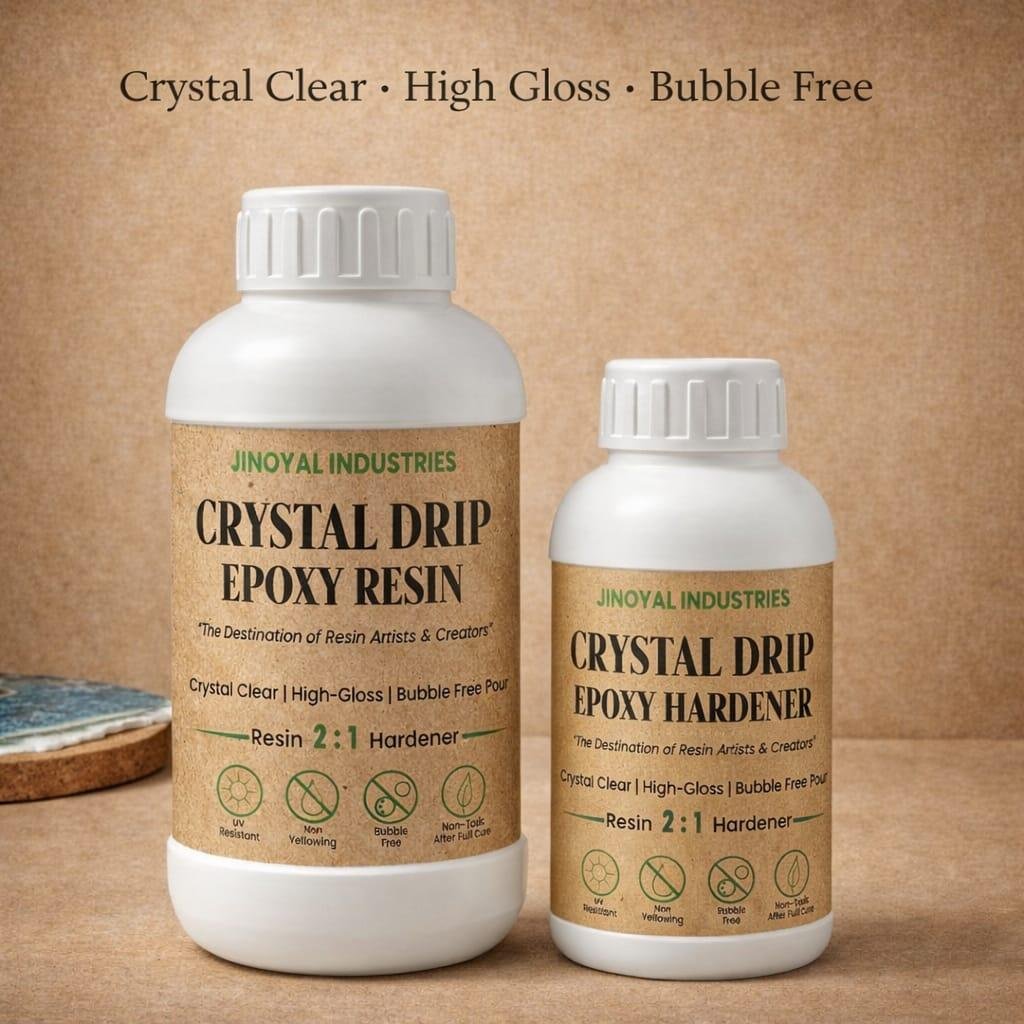
You can explore epoxy resin and hardener options from Jinoyal Industries Pvt. Ltd. for resin art and DIY applications. Check the product specifications, mixing ratio, working time, and recommended usage before purchasing.
Final Thought
Adding too much hardener to epoxy resin can create several problems, including sticky surfaces, improper curing, brittleness, discoloration, and reduced product performance.
The most important thing to remember is that extra hardener does not make epoxy resin stronger or guarantee faster curing. Resin and hardener must always be measured in the correct proportion to achieve the desired chemical reaction.
Whether you are working with Epoxy Resin, Epoxy Resin Hardener, Crystal Clear Epoxy Resin, or a complete Epoxy Resin Kit, following the manufacturer's mixing instructions is essential.
For beginners and experienced resin artists, choosing suitable Resin and Hardener, Bubble Free Epoxy Resin, and Non Yellowing Epoxy Resin can help achieve better results in decorative and creative projects.
If you are planning your next resin project, explore suitable Resin Art Supplies and choose a reliable Crystal Clear Epoxy Resin Kit that matches your application requirements.
Get in Touch
website : https://www.jinoyal.com/
E mail id : Support@jinoyal.com
Contact No : 9289666435
Insta id : https://www.instagram.com/jinoyal/


