

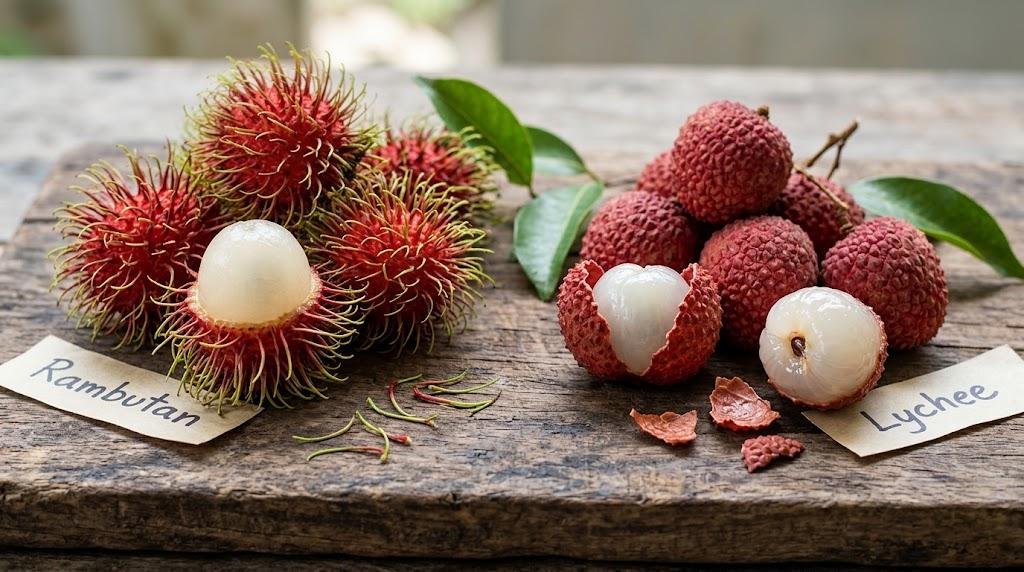

Rambutan vs Lychee
If you’ve ever stood at a fruit stall staring at two spiky, reddish fruits wondering if they’re the same thing, you’re not alone. Rambutan vs lychee is one of the most common mix-ups in the tropical fruit world, and honestly, it’s an easy mistake to make. Both are small, round, and have that same juicy, grape-like flesh hiding under an unusual shell. But once you taste them side by side, the differences become obvious. This guide walks through exactly how rambutan vs lychee compare, so you’ll never confuse them again. For more on tropical produce, check out [our other fruit guides] on the site.
Rambutan vs Lychee: What They Actually Are
Rambutan and lychee both belong to the same plant family, Sapindaceae, which is why they look like cousins. Lychee (Litchi chinensis) originated in southern China and has been cultivated for over a thousand years. Rambutan (Nephelium lappaceum) comes from Southeast Asia, particularly Malaysia and Indonesia. When people compare rambutan vs lychee, they’re really comparing two related fruits that evolved in different climates and developed their own distinct personalities. According to Wikipedia’s entry on rambutan, the name itself comes from the Malay word for “hair,” a nod to its spiky skin.
Rambutan vs Lychee: Appearance
This is the easiest way to tell them apart. Lychee has a smooth, bumpy, rose-red shell that looks almost like strawberry skin. Rambutan, on the other hand, is covered in soft, hair-like spines that stick out from a reddish or yellowish-green exterior. Despite the dramatic difference on the outside, the inside tells a different story. Crack either one open and you’ll find similar translucent, white, jelly-like flesh surrounding a single seed. So when judging rambutan vs lychee purely on looks, the shell is your giveaway, not the fruit itself.
Rambutan vs Lychee: Taste and Texture
Lychee tends to taste sweeter and more floral, with a texture that’s slightly firmer and juicier. Rambutan is sweet too, but it carries a milder, almost creamy flavor with a gentler bite. Some people describe rambutan as the “softer sibling” in this comparison. Neither fruit is sour, though an underripe lychee can lean tart. If you’re choosing between rambutan vs lychee based on taste alone, lychee usually wins for sweetness, while rambutan wins for a smoother, less intense flavor that’s easier to eat in large quantities.
Rambutan vs Lychee: Nutritional Value
Both fruits are low in calories and packed with vitamin C, making them genuinely good snack choices. A 100-gram serving of lychee provides roughly 71 calories and over 70mg of vitamin C, covering most of your daily requirement in one sitting, per USDA FoodData Central. Rambutan comes in slightly lower in sugar but still offers a solid dose of vitamin C, along with small amounts of copper and manganese. Neither fruit contains meaningful fat or protein, so in the rambutan vs lychee nutrition debate, it really comes down to which sugar level fits your diet better. Rambutan edges ahead for lower glycemic impact, while lychee delivers a slightly bigger vitamin C punch.
Rambutan vs Lychee: Health Benefits
Vitamin C is the standout benefit in both fruits, supporting immune function and skin health. Lychee also contains antioxidants called flavonoids, which research published in the National Institutes of Health database links to reduced inflammation. Rambutan contributes similar antioxidant activity and has traditionally been used in parts of Southeast Asia to support digestion, thanks to its fiber content. Looking at rambutan vs lychee from a wellness angle, both fruits support hydration and gut health, so eating either one regularly is a reasonable move if you enjoy them. For a broader look at how fruit fits into a balanced diet, see [our nutrition basics guide].
Rambutan vs Lychee: How to Eat Them
Preparation is nearly identical for both. Squeeze or twist the shell until it cracks, peel it back, and pop out the flesh. Watch for the seed in the middle; it’s not meant to be eaten raw in either fruit. Lychee works beautifully in fruit salads, cocktails, and even desserts like sorbet. Rambutan holds up well on its own as a snack, though it’s also delicious canned or added to tropical fruit platters. Whichever side of the rambutan vs lychee debate you land on, both taste best fresh and slightly chilled.
Rambutan vs Lychee: Which Should You Choose?
There’s no real losing option here. If you want a sweeter, juicier bite with a bigger vitamin C boost, go with lychee. If you prefer something milder, slightly lower in sugar, and a bit more fun to peel, rambutan is your fruit. Many people who try both end up keeping a rotation of each, since the rambutan vs lychee choice often comes down to mood and availability rather than one fruit being objectively better. Next time you spot either one at the market, grab a handful and decide for yourself.


